

 The Gambia
Visiting a School in The Gambia? How to Do It Right (Tips & Tricks)
Visiting a local school in The Gambia is an experience that stays with you forever. But how do you ensure your visit is helpful rather than intrusive? From avoiding “suitcase stress” to supporting the local economy: here is your guide to doing it right.
Traveling through The Gambia, you’ll eventually pass a school where the enthusiasm is so loud you can hear it three streets away. For many travelers, it’s a logical stop; peeking into a classroom full of kids is simply an unforgettable experience. And let’s be honest, it’s a welcome change from the tenth mango seller along the road.
Quick Guide: your checklist for a great and responsible school visit
Short on time and don’t want to read the whole post? (A shame, but we’re still friends.) Here are the absolute must-knows:
- ✔ Donating? Buy local: Leave the suitcases full of pens at home. Buy notebooks, pencils, and soap at the local market. Good for the school, good for the Gambian trader.
- ✔ No candy: Think: dental problems, and dentists are scarce in The Gambia. Better to give children something they can actually use in class.
- ✔ Headmaster first: Don’t just walk into a classroom. Report to the Headmaster. He or she knows exactly where the need is greatest and ensures that items are distributed fairly.
- ✔ Privacy above all: Always ask permission for photos. An atmospheric shot is beautiful, but respect the privacy of the children.
- ✔ The pro-level move: Ask for the local tailor for uniforms or donate hygiene products (such as soap or sanitary pads). That often makes more of a difference than yet another colored pencil.
To be fair: during our very first trip to The Gambia, visiting a school was not exactly at the top of our list. It was our cheerful guide/driver who pointed it out to us: “You absolutely won’t regret it!” We were on our way from Georgetown to the capital Banjul and along the way there was not much to see, except for a large plain with only tiny villages here and there. We wondered if we could just visit a school without a prior appointment? “No worries folks, trust me,” our driver turned into a side road, and a few minutes later, in the middle of nowhere, a small school indeed appeared.
The enthusiasm of the school children was, in any case, indescribable. Laughing, singing, shouting… as if we were long-awaited guests. And when they noticed our cameras, it was a scramble; everyone wanted to be the star of the photo. But honestly? There we stood. With our best intentions, our expensive lenses and… completely empty-handed. You feel in everything that you want to give something back for that spontaneous hospitality, but you also don’t want to be the next tourist who hands out items at random (or worse: standing there empty-handed). Eventually, we gave the headmaster a contribution to sponsor the school, but we promised ourselves one thing: we will never make this unprepared blunder again.
After some research and a few good conversations on the spot, we now know better. Because those good intentions are great, but how do you tackle it smartly without your suitcase exploding with pencils and pens?
- 1. How do you arrange such a visit? (without it becoming awkward)
- 2. The suitcase stress: why buying local is the ultimate hack
- 3. No candy, but a plan: the unwritten rules of the playground
- 4. The smile-shock: be prepared for enthusiasm
- 5. Click or look? About privacy and that “perfect” photo
- 6. Green fingers in class: the rise of School Gardens
- 7. WASH: why soap is sometimes more important than notebooks
- 8. A few more tips to remember
- 9. And what about when you are back home? (spoiler: it doesn’t stop at the border)
1. How do you arrange such a visit? (without it becoming awkward)
Of course, you cannot just storm into the middle of a math lesson. There are a few ways to handle this neatly:
- Via your Guide or Driver: Ask your regular taxi driver or local guide. High chance that his nephew or neighbor’s daughter is at a school that could use some extra support. Please note: always check if the school is actually waiting for a visit at that moment.
- Via the hotel: Many hotels have a close bond with a nearby school. They can often arrange an excursion where part of the proceeds (or your donation) goes directly to the classrooms.
- Via foundations and organizations: Contact an organization in Belgium or the Netherlands that supports schools beforehand. They know exactly where the help is needed most at that moment. You will certainly find one in your region by simply asking Google. They ensure that your visit does not become ‘monkey watching’, but a valuable exchange.

2. The suitcase stress: why buying local is the ultimate hack
You really don’t have to sacrifice your entire luggage space to notebooks from the Action. In fact: you can easily save yourself those extra kilos of hauling. We used to think we were saving the Gambian economy by lugging three kilos of ballpoint pens from Belgium or the Netherlands. Spoiler alert: you don’t have to.
It is meant very sweetly, of course, but actually not the smartest way to help. Nowadays, everything is about local impact. Here is why you are better off leaving those extra kilos of luggage at home:
- Support the local economy: If you buy your notebooks and pencils at the market in Serrekunda or at a local stationer near your hotel, you help twice. The school gets its supplies, and the local trader can support his family. Win-win!
- Quality and relevance: The teachers know exactly which type of notebooks or materials are needed at that moment. Sometimes they benefit more from chalk for the board or simply soap for the hand-washing stations than from yet another set of felt-tip pens.
- Less plastic, less waste: By buying locally and unpackaged, you prevent introducing a lot of European packaging plastic into a country where waste processing is often still a challenge.
My tip: Set aside a morning to go to the market together with your guide. It is an experience in itself (the colors, the smells, the chaos!…) and you know 100% sure that you arrive at the school with the right supplies. Moreover, the gratitude of the local seller is often just as great as that of the schoolchildren.
Did you know? In many Gambian schools, pencils are more valuable than pens. Why? A mistake with a pencil can be erased, so a notebook stays neat much longer and can be used optimally.
Also useful: Try to arrange a visit to a more remote school. These receive very few visits from tourists and obviously have more need for financial help and school supplies. You will be received twice as enthusiastically here.
3. No candy, but a plan: the unwritten rules of the playground
I know, those twinkling eyes and those outstretched hands… it’s incredibly hard to say no. But if there is one thing that was emphasized to me during my first school visit, it is this: leave those bags of lollipops and sweets at home.
Why? First of all: children love to flutter around you in (large) groups. You can be sure that you’ll never have enough candy to serve everyone. But there is an even more important reason: in The Gambia, the dentist is a luxury that most parents cannot afford. A cavity here often doesn’t mean a filling, but an immediate extraction. Very sad, so: don’t do it!
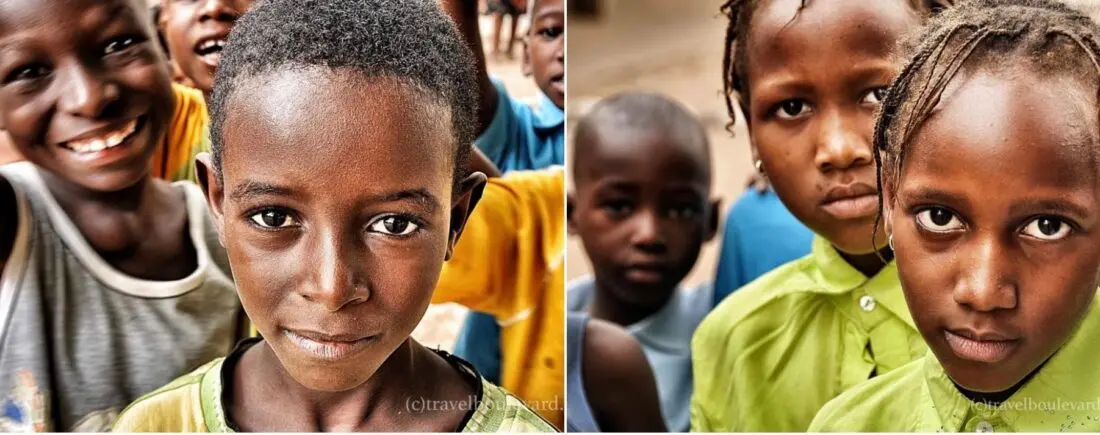
The rule: Never give anything directly to a child on the street or on the playground. No matter how cute they are. By doing so, you teach them that begging pays off, and your gift often ends up with the boldest children, not the ones who truly need it. Meet the headmaster or the teacher, shake hands, have a chat, and hand over your donation there. This way, the items are distributed fairly among the kids who need them most.
4. The smile-shock: be prepared for enthusiasm
In the interior of The Gambia, being a white face still makes you an attraction. Some children rarely see visitors and react – to say the least – rather exuberantly.
- Stay calm: It can be overwhelming when twenty children are suddenly hanging off your arm. Inhale, exhale, and enjoy the chaos.
- Wait for the signal: Don’t storm toward the children yourself. Let them come to you. In Gambian culture, waiting is often more powerful than immediately demanding attention.
- Don’t play ‘Santa Claus’: No matter how tempting it is to wave items around: don’t do it. It creates an unhealthy dynamic. Give your supplies to the teacher and focus on the interaction. A high-five or a simple game is often worth more than a plastic pen.
5. Click or look? About privacy and that “perfect” photo
Of course, you want to capture those beautiful faces for the folks back home (and okay, for your Insta feed). But meanwhile, fortunately, we have become much more aware of privacy. Just think about it: would you be okay with a complete stranger walking into a classroom in Belgium or the Netherlands and starting to photograph your child? Exactly.
- Just ask: Ask the teacher first. Usually, they think it’s great, but it’s a matter of respect and politeness.
- The “connection check”: Put that smartphone away every now and then. Play a game of soccer, sing along with the songs, show them the buttons on your camera. The most beautiful memories are in your head.

6. Green fingers in class: the rise of School Gardens
What I find so incredibly beautiful about Gambian schools is the focus on self-sufficiency. More and more schools have their own School Garden. And no, that’s not a boring patch with three carrots, but a serious operation where the kids learn how to grow their own food.
Often you see that the yield of these gardens – from mangoes to cassava – is used for school meals. Sometimes they even sell a portion at the local market to buy new books. Ask about it during your visit. It’s the ultimate way to start a conversation that goes beyond just “hello.” And who knows, you might even be allowed to help with watering if you feel so inclined.
7. WASH: why soap is sometimes more important than notebooks
You might not expect it immediately, but one of the biggest challenges for a school in The Gambia is not the lack of pens (even though they can use them badly), but access to clean water and good hygiene. They call this the WASH project (Water, Sanitation, Hygiene).
Imagine: a class with sixty children, one tap that fails more often than not, and no soap. That’s a recipe for infections, causing half the class to be home sick all the time. If you really want to make an impact, ask the headmaster if there is a need for support in this area.
What can you do specifically?
- Hygiene kits: Think of large bottles of liquid soap or disinfectant gel for the handwashing stations. It might sound like an unexciting gift, but for a school, it is a godsend.
- Water tank maintenance: Many schools have a tank, but it needs regular maintenance or a new filter. With a small financial contribution to the school fund, they can often arrange this locally themselves.
- Education material: Sometimes schools are also helped with simple posters (printed locally!) that explain the importance of washing hands.
The beauty of WASH is that it forms the foundation. No education without health. If a child doesn’t get sick from contaminated water, they don’t miss lessons. It’s that simple (and crucial). So yes, those colored pencils are great for creativity, but a bar of soap and a working tap ensure that those kids are actually in their desks to use them.
8. A few more tips to remember
- The Tailor Hack: In The Gambia, almost all children wear a school uniform. For the poorest families, purchasing one is a huge barrier. Do you want to do something truly tangible? Ask the school principal for the local tailor who sews the uniforms. You pay the bill (it often costs less than a lunch at home), the tailor has work, and a child can attend class without worry.
- Sanitary pads & hygiene: For the girls in the Senior Secondary Schools, this is a massive stumbling block. Many girls are forced to stay home one week a month because they don’t have proper hygiene products. By donating kits (preferably reusable pads, which are more sustainable), you ensure they don’t have to miss a single day of school. It might not be the most ‘sexy’ gift, but the impact on their school results is enormous.
- Respect the break (and the exams): Nothing is as disruptive as a class that is in the middle of an important test and is suddenly distracted by a group of enthusiastic travelers. In The Gambia, studying is taken seriously—do not underestimate that. Therefore, always plan your visit in consultation, for example with a local guide. They know exactly when the break is or when classes are over, so you can drop by at a quiet moment without disrupting everything.
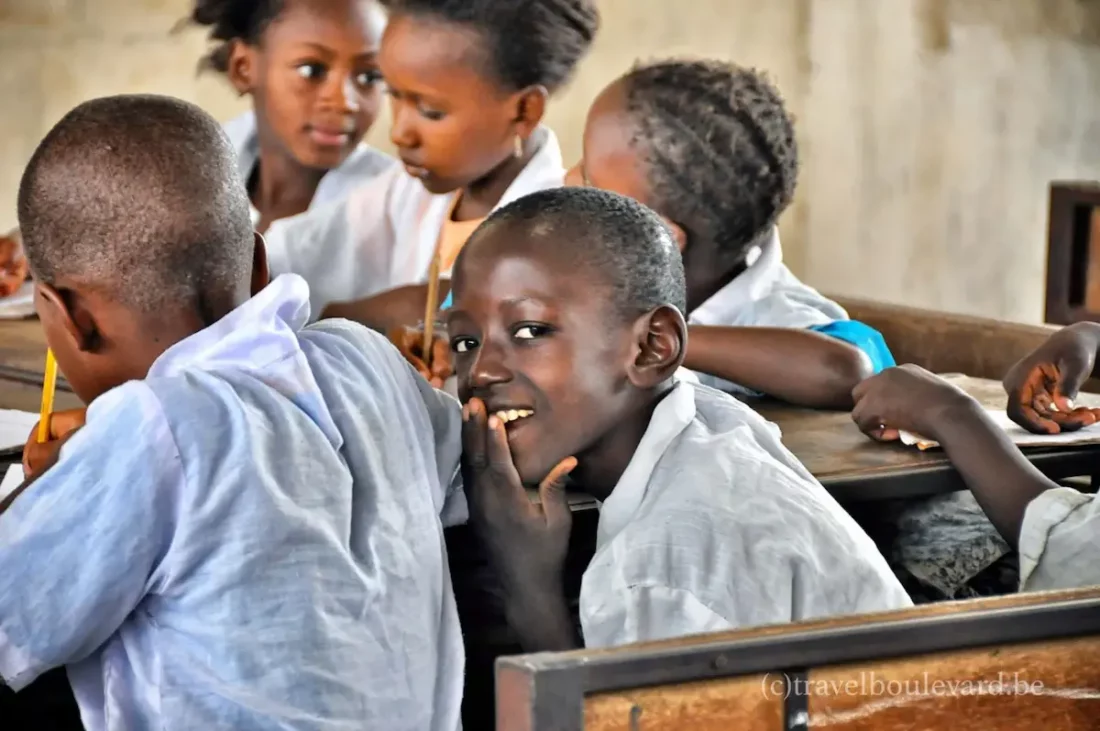
9. And what about when you are back home? (spoiler: it doesn’t stop at the border)
There you are, safely back on your own couch with a cold beer or a latte, scrolling through your photos of Tanji or Kotu, thinking back to that group of cheerful kids in the countryside with a big smile. It’s a memory that stays with you for a long time, but also one that might nag at you a little. Because how do you ensure that your visit wasn’t just a one-time “tourist extra”?
Believe me, you don’t have to quit your job to start an NGO. If you really want to make a contribution, the smartest move is to support an organization that is active year-round and has already proven to work efficiently.
- Large and small projects: In The Gambia, education is the absolute engine of the economy, but it is not a given for every family that all children are in school. Organizations or small-scale projects ensure that children get the chance to finish their education. Often, the emphasis is extra on the girls (girl power!), simply because they are often the first to have to stay home to help during difficult times. By removing that barrier, you help the entire community move forward.
- Direct impact: Your contribution then goes directly toward school desks, repairing a roof that leaks during the rainy season, or – crucially – teachers’ salaries. Because without a teacher, it all stops quickly. Know that at small community schools, the teacher’s salary often depends on the school fees paid by parents. If those fees aren’t there (for example, due to a disappointing harvest), a foundation ensures that lessons can continue as usual. This keeps the quality of education stable for the whole class, even when times are tough.
- No “white savior” complex: The beauty of these foundations is that they work with the local community. They ask what the school needs, instead of deciding for themselves what should happen.
- Become an ambassador: Sometimes just sharing your story is enough. Tell friends who are also going to The Gambia about the “tailor hack” or the importance of those bars of soap. The more travelers look at a school this way, the fewer pens remain unused in a cupboard.
In short: your vacation might be over, but your connection with The Gambia doesn’t have to be. By visiting a school in a thoughtful way, you don’t just take home a beautiful memory, but you leave something behind that truly benefits the local community. And let’s be honest, doesn’t that feel much better than yet another magnet on your fridge? Have fun!
Comments are closed.
Amazing photography skills!!!
Tx Raphael! 🙂
Great tips and fantastic photos! It’s always commendable trying to give something back, but it’s also necessary to know the right procedure. As you say, it’s tough for any kid to feel left out. Good luck and safe travels!
Great photos! Giving back on travels is so wonderful. We’ve visited several schools in Costa Rica and it’s always been an amazing experience.
Giving back as you travel! Isnt that grand, I like the tip about giving the items to the staff. I would just start handing them out, and then I’d feel rotten for those kiddies who missed out. Also thanks for linking up with us for Sunday Traveler, would be great if you can link back to one of the hosts / add the badge when you can.
Photos are amazing! It makes me so said to know that these kids miss such an essential things like pencils (not to mention food!). Lovely article, and I am sure very enriching experience.
Yes, the kids miss so much things, and yet they were so kind and proud. Really makes you think about how lucky we are.
Some great tips, and your photos are beautiful! I would love to visit one day!
Tx Emma!
Oh wow that sounds amazing!! I love your photos too.
Thank you 🙂
Nice post – looks like a great experience. I was in the Gambia earlier this year but had a worrying visit to Juffure on the Roots trail – a sad case of tourism gone bad with children encouraged into begging. This sounds like a much nicer way to interact.
Hi Jo! Yes, children who are encouraged into begging is so wrong, on so many levels. I think that, as a tourist or traveler, you can enjoy the countries you’re visiting, but you also have responsibilities. That’s why I never give money or candy to children (or grownups) who beg. I do support some charity organizations, these are much better trained in helping than me :).
I’ve just read your posts on The Gambia: really great writings! It was so recognizable, you describe it really as it is!