
 France
Marseille Travel Guide: Raw, Sunny and Beautifully Chaotic (Things to Know Before You Go)
Marseille isn’t the prettiest or most polished city in France. And honestly, that’s exactly what I like about it. It’s large, lively, and at times chaotic. While there’s plenty to see, you won’t spend your days frantically ticking off sights. Much of the appeal lies in simply walking through the different neighbourhoods, grabbing a drink, or finding a spot by the sea.
I’ve visited Marseille twice now. On my first trip, I stayed near the Vieux-Port; on my most recent visit, I spent a longer period in Le Camas. They are two very different sides of the same city, and staying in Le Camas for longer gave me a much better perspective on how Marseille actually works.
You don’t need things to be neat and tidy to enjoy this place. Walk through the narrow streets of Le Panier, take the bus up to Notre-Dame de la Garde, or lace up your walking shoes for the Calanques. Marseille isn’t for anyone looking for manicured parks and sleek perfection. It is for people who appreciate a city with edge, character, and genuine atmosphere.
In this guide, I’ll take you through the places I personally found worth the time, along with a few practical details that are worth knowing before you head over.
- 10 Things to Do and See in Marseille
- 1. ⚓ Vieux-Port: Marseille’s Historic Harbor
- 2. 🧱 Le Panier: Marseille’s Oldest Quarter
- 3. ⛪ Notre-Dame de la Garde: Panoramic Views Over the City
- 4. 🌊 Mucem & Fort Saint-Jean: Modern Architecture Meets History
- 5. 🏖️ Beaches & Swimming: City Spots Along the Coast
- 6. 🎨 Cours Julien: Street Art, Vintage Shops, and Local Life
- 7. 🐟 Vallon des Auffes: Traditional Fishing Harbour Under the Viaduct
- 8. 🥾 Les Calanques: Limestone Cliffs and Clear Waters
- 9. 🏛️ Palais Longchamp: Monumental Water Palace and City Park
- 10. 🧿 Noailles: Marseille at Its Most Multicultural
- More Things to See in Marseille
- Where to Stay in Marseille: Best Neighbourhoods and Hotels
- ⚓ Vieux-Port: Best for First-Time Visitors
- 🧱 Le Panier: Atmospheric and Historic
- 🎨 Cours Julien: Cafés, Street Art, and Nightlife
- 🧿 Le Camas: Local Atmosphere Away from the Crowds
- 🏖️ Prado & the Coast: Best for Beaches and Sea Views
- 🛏️ Not sure where to stay yet?
- Food & Drink in Marseille: Beyond Bouillabaisse
- Practical Information for Your Trip
- Day Trips from Marseille: Four Different Escapes
- ❓ Frequently Asked Questions About Marseille
🇫🇷 MARSEILLE AT A GLANCE: QUICK GUIDE
- ☀️ Best time to visit: May–June and September–October. Spring and autumn bring pleasant temperatures and fewer crowds than high summer. July and August work too, but expect high heat. September remains warm and summery, while October averages around 20 °C.
- 🗓️ How many days? Three full days give you a solid foundation for Marseille itself, including a trip to the Calanques. Add an extra day or two if you also want to visit Cassis or Aix-en-Provence.
- 🚆 Getting there: From Brussels-South (Midi), direct TGV INOUI trains reach Marseille Saint-Charles in about 5.5 hours. From London, high-speed Eurostar trains run via Paris or Brussels.
- 🚇 Getting around: The RTM metro, tram, and bus networks are straightforward to use. 24-hour and 72-hour passes are available. Bus 60 takes you straight up to Notre-Dame de la Garde.
- 🥾 Visiting the Calanques: Free online reservations are mandatory for Sugiton and Pierres Tombées on busy summer days. Always check access conditions beforehand, as summer fire risks can temporarily close parts of the national park.
- 🎟️ Cosquer Méditerranée: If you plan to visit this underwater cave replica, book your time slot online in advance as visitor capacity is limited.
10 Things to Do and See in Marseille
1. ⚓ Vieux-Port: Marseille’s Historic Harbor
The Vieux-Port is the historic core of Marseille and the place where the city wakes up each morning. Early in the day, fishermen sell their fresh catch directly from the quay. Take a moment to walk beneath the massive mirrored canopy designed by architect Norman Foster for an amusing perspective on the people passing by. The Old Port is a good spot for a drink on an outdoor terrace, though you’ll pay a little extra for that view of the boats.
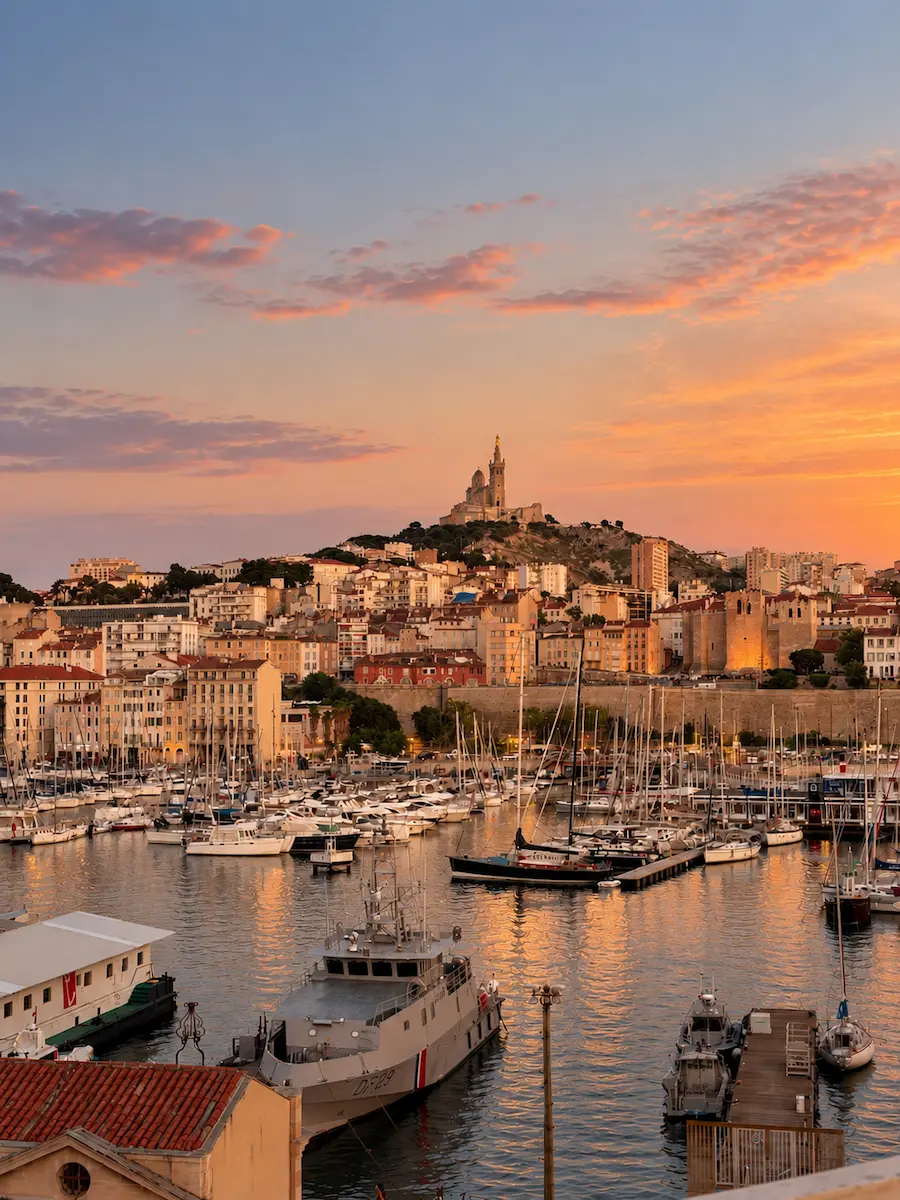
- Practical: The central hub for metro, bus, and ferry services. Many walks through the city start right here.
2. 🧱 Le Panier: Marseille’s Oldest Quarter
Le Panier is the oldest quarter of Marseille: a maze of steep alleys, stone staircases, painted façades, and bold street art. Alongside shopfronts aimed squarely at visitors, you will still find traditional soap workshops, local boutiques, and small cafés. Place de Lenche is a great spot to pause for an ice cream or a glass of pastis and watch neighbourhood life go by.
Practical: Leave high heels behind and wear comfortable walking shoes. Your calves will thank you, as flat ground is practically non-existent here.
3. ⛪ Notre-Dame de la Garde: Panoramic Views Over the City
La Bonne Mère, as locals call the basilica, sits atop Garde Hill. The view from the terrace is easily the best in Marseille, taking in the entire harbour, the rocky islands, and the Mediterranean Sea. Inside, hundreds of small model ships hang from the vaulted ceilings, donated by sailors seeking protection at sea.
You can walk up from the harbour, but in 30-degree heat under the full sun, bus 60 is a considerably more reasonable choice.

Practical: Access to the basilica is completely free. Bus 60 departs directly from the quayside at the Vieux-Port.
4. 🌊 Mucem & Fort Saint-Jean: Modern Architecture Meets History
The Mucem (Musée des Civilisations de l’Europe et de la Méditerranée) is one of the city’s most striking modern landmarks. Its dark, lattice-like concrete exterior forms a sharp contrast with the centuries-old Fort Saint-Jean right beside it.
An elevated pedestrian bridge connects the museum directly to the historic fort. Useful budget tip: you don’t need a museum ticket to walk across the bridge or wander through the fort’s gardens. It’s entirely free and offers great open views across the sea.

Practical: The outdoor walkways and the fort grounds are free to access. You only need a ticket if you want to visit the indoor exhibitions at the Mucem.
5. 🏖️ Beaches & Swimming: City Spots Along the Coast
Marseille is primarily a port city, but you don’t have to go far to cool off in the Mediterranean. There are several city beaches within easy reach, from the compact Plage des Catalans near the centre to the wider stretches along the Prado coastline. Pointe Rouge is another option further down for swimming and water sports.
The water is pleasant in summer, but don’t expect endless soft sand like elsewhere along the French coast. Several beaches are pebbly or have coarse sand, and they can get pretty packed during peak season.

6. 🎨 Cours Julien: Street Art, Vintage Shops, and Local Life
Cours Julien is the city’s raw, creative hub. Almost every square metre of wall space here is covered in graffiti and colourful murals. Between the vintage clothing shops, second-hand record stores, and small boutiques, the atmosphere is relaxed and easygoing. It’s a great area to wander around during the day, while by late afternoon, locals start filling the outdoor terraces.

Practical: Take metro line M2 to Notre-Dame du Mont station and walk into the neighbourhood via the large, mural-painted staircase.
7. 🐟 Vallon des Auffes: Traditional Fishing Harbour Under the Viaduct
Vallon des Auffes is a tiny traditional fishing harbour tucked beneath the arches of the busy Corniche Kennedy coastal road. The brightly painted wooden fishing boats (pointus) and small houses around the inlet make this one of the most picturesque spots in the city.
Don’t expect a major tourist attraction; you come here to stroll along the quay, watch the fishermen, or sit on the stone wall with a drink as the sun goes down.

Practical: Take bus 83 from the Vieux-Port and get off at the Vallon des Auffes stop.
8. 🥾 Les Calanques: Limestone Cliffs and Clear Waters
The Calanques are a major draw for many visitors to Marseille: steep limestone cliffs, small inlets with clear water, and spectacular coastal trails. However, going unprepared is a mistake. The national park faces drought and erosion, and parts of the area can be closed at short notice when fire risk is high.
For the popular Calanque de Sugiton, free online reservations are mandatory during the summer months. Without a QR code on your phone, you simply won’t be allowed in.
I visited the Calanques using public transport, which works well if you want to combine a proper hike with a swim.

Practical: Bring at least two litres of water per person and wear sturdy hiking shoes. Flip-flops are a guaranteed recipe for misery.
👉 Prefer not to sweat on steep trails? Daily boat tours depart directly from the Vieux-Port, offering views of the Calanques from the water.
9. 🏛️ Palais Longchamp: Monumental Water Palace and City Park
Palais Longchamp looks at first glance like the grand residence of a lavish royal family, but its origins are much more practical. The monument was built in the 19th century to celebrate the arrival of fresh drinking water in the city via the Canal de Marseille.
The massive central waterfall, fountains, and curved colonnade are impressive. Parc Longchamp behind the monument is also a pleasant, quiet retreat when you need a break from the traffic and bustle of the city.

Practical: Reachable within minutes via tram line T2 (Longchamp stop). Access to the park and the monument itself is free.
10. 🧿 Noailles: Marseille at Its Most Multicultural
Around Rue d’Aubagne and the Marché des Capucins, Marseille feels noticeably different from the waterfront. North African bakeries, spice merchants, greengrocers, and small eateries sit side by side. It is busy, colourful, and occasionally chaotic, giving the neighbourhood a distinct, lively energy.
More Things to See in Marseille
Have extra time or want to explore beyond the classic sights? These options are worth keeping in mind:
- 🏢 Cité Radieuse: Le Corbusier’s famous 1952 residential complex, worth a visit for architecture enthusiasts or anyone curious about radical post-war housing design.
- 🐚 Cosquer Méditerranée: An accurate reconstruction of the prehistoric underwater cave located off the Marseille coast.
- ⛪ Cathédrale de la Major: The grand, striped cathedral on the Quai de la Joliette, right next to Mucem.
- 🏰 Château d’If: The former island fortress off the coast, best known as the setting for The Count of Monte Cristo.
- 🏝️ Îles du Frioul: An archipelago near the city featuring walking trails, small coves, and sweeping views back towards Marseille.
- 🌊 La Corniche Kennedy: A long coastal boulevard overlooking the Mediterranean, ideal for a walk or a ride on the local bus.
- 🌿 Parc Borély: A large public park near the coast, with gardens, greenery, and space to escape the city traffic for a while.
- 🏛️ Musée des Beaux-Arts: Located inside Palais Longchamp, for anyone who wants to see the art collection as well as the impressive building itself.
Where to Stay in Marseille: Best Neighbourhoods and Hotels
Marseille is spread out, and the atmosphere changes quickly once you walk a few blocks away from the Vieux-Port. For a first visit, I’d focus on the Vieux-Port, Le Panier, Cours Julien, Le Camas, or the neighbourhoods along the coast.
⚓ Vieux-Port: Best for First-Time Visitors
The Vieux-Port is the most practical choice if you are visiting Marseille for the first time. You stay right in the centre, within walking distance of Le Panier, Mucem, and dozens of terraces. Metro, bus, and ferry connections are directly on your doorstep. The downside? As the most popular area to stay, room rates are slightly higher on average.
- 💰 Budget: Hôtel Hermès – Simple and exceptionally well located right on the harbour, with a pleasant rooftop terrace.
- 💶 Mid-range: Hôtel Carré Vieux Port – Central, comfortable, and practical for exploring the city on foot.
- 💎 Luxury: Hôtel La Résidence Du Vieux Port – Set right on the quay, with rooms overlooking the harbour towards Notre-Dame.
- 👑 Five-Star Luxury: InterContinental Marseille – Hôtel Dieu – Housed in a monumental 18th-century building overlooking the port. One of the city’s high-end options.
🧱 Le Panier: Atmospheric and Historic
If you prefer stepping straight out of your hotel into narrow historic streets, Le Panier is a charming base. You are a short walk from the harbour and Mucem, surrounded by colourful façades, street art, and small cafés. Keep in mind that the area is full of steep staircases and cobbled alleys, meaning taxis cannot always drop you off right at the front door.
- 💰 Boutique & Character: Au Vieux Panier – A unique B&B in the heart of the quarter, where each room is styled by a different artist.
- 💶 Mid-range: Best Western Hôtel du Mucem – Well-run and conveniently set on the edge of the neighbourhood, close to both the harbour and museums.
- 💎 Luxury: InterContinental Marseille – Hôtel Dieu – Sitting right on the border between Le Panier and the Vieux-Port, making it an ideal choice if you want historic character combined with five-star amenities.
🎨 Cours Julien: Cafés, Street Art, and Nightlife
Cours Julien is the place to stay if you appreciate lively cafés, outdoor terraces, and a creative edge. Independent boutiques and murals define the surrounding streets. Sitting slightly higher up in the city, it remains within easy walking distance of the central sights.
- 💰 Budget: Ibis Marseille Centre Préfecture – Simple, dependable accommodation in the 6th arrondissement, a short walk from Cours Julien.
- 💶 Mid-range: Maison Juste – A stylish, small-scale boutique stay within walking distance of Cours Julien.
- 💎 Design Luxury: Hotel C2 – A beautiful design hotel in a converted mansion with an indoor pool, a short distance from both Cours Julien and the harbour.
🧿 Le Camas: Local Atmosphere Away from the Crowds
On my first trip to Marseille, I stayed near the Vieux-Port. On my second visit, I chose Le Camas in the 5th arrondissement and stayed there for longer. It offered a completely different perspective on the city. Rather than stepping out into major tourist sights, you find a residential area with neighbourhood bakeries, local places to eat, and everyday city life. If you have already seen the main highlights, this makes a great alternative base.
- 💰 Budget: Ibis budget Marseille Timone – Basic, practical, and budget-friendly.
- 💶 Mid-range: Ibis Marseille Timone – Offers slightly more comfort and a reliable breakfast at the same convenient location.
- 💎 Boutique Option: Grand Juste – A modern concept featuring an inner garden in the 5th arrondissement, ideal if you prefer a smaller-scale place to stay.
🏖️ Prado & the Coast: Best for Beaches and Sea Views
If you want to combine a city break with time by the water, look further south along the coastline near Prado, Endoume or Corniche Kennedy. Staying here puts you close to the sea, with plenty of opportunities for swimming or walking along the coast. While you trade away immediate access to central sightseeing, you gain sea air, nearby beaches, and clear sunset views.

- 💰 Budget: B&B HOTEL Marseille Prado Parc des Expositions – A straightforward, practical choice close to Parc Chanot and the Prado. Ideal if you’re looking for an affordable base and plan to spend most of your days exploring the city.
- 💶 Mid-range: Hôtel Mercure Marseille Centre Prado Vélodrome – Offers more comfort and a quiet location near the Prado, within easy reach of the beach. A good middle ground if you want a little more comfort without moving into luxury-hotel prices.
- 💎 Iconic Luxury: Le Petit Nice Passedat – A world-famous luxury hotel and restaurant perched directly on the rocks of Endoume. For those who like the idea of waking up to the sound of the waves.
So, Which Neighbourhood Should You Choose?
- First time in Marseille? Choose the Vieux-Port. You can reach almost everything on foot, with bus and ferry connections right on your doorstep. Le Panier is another good option if you prefer staying among narrow historic streets, terraces, and colourful façades.
- Second visit or looking for local atmosphere? Go for Le Camas or Cours Julien. You’ll be among locals and experience a completely different side of the city.
- Coming for the sun and sea? Look for somewhere around Prado or along the Corniche coastal road.
🛏️ Not sure where to stay yet?
Marseille has quite a few different faces. One neighbourhood is particularly convenient for a first city break, while another is a better fit if you want to experience more of local life. And then there are the neighbourhoods by the sea.
👉 Check out my guide to the best neighbourhoods and hotels in Marseille and find out which area suits your city break best.
Food & Drink in Marseille: Beyond Bouillabaisse
Marseille has a strong reputation as a seafood city, and rightly so. The most famous speciality is, of course, bouillabaisse, but don’t expect the simple fishermen’s stew of the past. Traditional bouillabaisse is prepared with several types of Mediterranean fish and served in two distinct courses: first the broth, then the fish, accompanied by bread and rouille, a punchy garlic sauce.
And yes, it comes with a hefty price tag. Proper bouillabaisse isn’t a quick, cheap lunch you squeeze in between two sights. If you spot a suspiciously cheap ‘bouillabaisse’ on a menu around the Vieux-Port, keep walking. Traditional preparation requires fresh fish and plenty of culinary skill, and an authentic version will reflect that in the price.
Fortunately, you don’t need to like seafood to eat exceptionally well here. Panisses (fried chickpea-flour fritters) are the ultimate Marseille snack and naturally vegetarian. Provençal classics built around fresh vegetables, pulses, and olive oil are also widely available.
Then there is Noailles, where Marseille’s North African influences really come to the fore. Around Rue d’Aubagne and the Marché des Capucins, you’ll find bakeries selling fresh baklava, fragrant spice shops, and small eateries serving excellent couscous and tagines without the price tag of a meal by the harbour.
🌱 Prefer Vegetarian or Vegan? Finding plant-based food is no longer an issue in Marseille. Cours Julien in particular has plenty of vegetarian and vegan bistros, while you’ll also find increasingly more fully plant-based menus in Le Panier and around the Vieux-Port.
🍹 The Daily Apéro & Happy Hour Around five o’clock, the city’s tempo shifts. Locals swear by their apéro, and Marseille takes its Happy Hours seriously. While many French cities offer a brief one-hour discount, bars around Cours Julien, Notre-Dame-du-Mont, and the Vieux-Port often reduce their prices for beer, wine, and cocktails well into the evening, sometimes until 21:00 or 22:00.
- Ordering Pastis: The ultimate local thirst-quencher is pastis, an anise-flavoured spirit. If you order a jaune or petit jaune, you’ll get a measure of pastis along with a carafe of ice-cold water to dilute it yourself.
- Where to go: The terraces in Cours Julien and the bars along the Vieux-Port both fill up quickly for this daily ritual. Grab a seat around 18:00 and you’re set until dinner.
Practical Information for Your Trip
🚆 Getting to Marseille by Train From Brussels-Midi, you can travel directly to Marseille Saint-Charles via TGV INOUI, with the fastest journey taking around 5½ hours. From Amsterdam, you can take the high-speed train with a change in Brussels or Paris. Saint-Charles station is remarkably central; walk out of the station, descend the monumental staircase, and you’re immediately in the city.
🚇 Getting Around the City You absolutely don’t need a car in Marseille. The RTM network’s metro, tram, and buses will get you to most major sights without much trouble. For the steep climb to Notre-Dame de la Garde, bus 60 is the sensible option.
My advice: Leave the car behind if you’re only visiting the city. Traffic can be chaotic, narrow streets are awkward to navigate, and finding parking is simply not a hobby.
🥾 The Calanques: Read This Before You Go Access to the Parc National des Calanques is strictly regulated between 1 June and 30 September because of wildfire risk. During periods of extreme heat, drought, or strong winds, parts of the park can be closed completely at short notice.
Access to Calanque de Sugiton and Les Pierres Tombées also requires a free online reservation on designated busy summer days. For 2026, this applies from 27 June through 30 August, plus the consecutive weekends of 5–6 and 12–13 September.
Important: Always check the official Parc National des Calanques app or website on the morning of your planned hike. Access conditions can change from one day to the next.
💶 Payment and Safety Card payments and contactless are accepted almost everywhere. A little cash is useful at local markets, such as the morning fish market, or in very small neighbourhood shops.
As for safety: Marseille is a large, gritty port city. As in any major European metropolis, keep an eye on your belongings in crowded places and on the metro, and use common sense in the evening. There’s really no need to overthink it.
Day Trips from Marseille: Four Different Escapes
Marseille is an excellent base for exploring the wider region, and you don’t need to rent a car to do it. Trains, buses, and boats connect the city with beaches, Provençal towns, and the Calanques.
🏖️ Cassis: Harbour, Calanques and Swimming Cassis is one of the best-known day trips from Marseille. The small harbour is pleasant for a stroll, but the real reason to come here is the Calanques. From Cassis, you can walk to Port-Miou and continue to Port-Pin, which has a small beach surrounded by pine trees and is a popular spot for swimming. If you want a longer hike, continue to the spectacular Calanque d’En-Vau, which takes around 1½ to 2 hours from Port-Pin.
👉 Book your day trip or activities in Cassis here.
🌊 Les Goudes: The Other Marseille Located on the far south-western edge of the city, Les Goudes sits at the gateway to the Calanques massif. This tiny fishing harbour feels a world away from the bustle of central Marseille. From here, the road continues towards Callelongue, where several hiking routes into the Calanques begin.
👉 Browse tours and activities around Les Goudes and the Calanques here.
🌿 Aix-en-Provence: A Complete Contrast If you need a break from limestone cliffs and Marseille’s chaotic energy, Aix-en-Provence offers something entirely different. Think broad, tree-lined avenues, fountains, markets, terraces, and classic Provençal architecture. It’s a good option if you fancy a quieter day out.
👉 Browse day trips and excursions to Aix-en-Provence here.
🏰 Château d’If: An Island with a Story Sitting on a small island just off the coast, Château d’If is best known for its connection to Alexandre Dumas’ The Count of Monte Cristo. The former fortress and prison can be reached by boat from Marseille and combined with a visit to the nearby Frioul Islands.
👉 Find tickets and boat tours to Château d’If here.
My advice: If you only have three days in Marseille, don’t try to organise a half-Provence tour as well. Pick one day trip and save the rest of your time for the city itself. Choose Cassis if you want coastal scenery, swimming, and hiking; choose Aix-en-Provence if you fancy a completely different atmosphere.
❓ Frequently Asked Questions About Marseille
Is Marseille worth visiting?
Yes. Marseille is particularly rewarding if you enjoy a mix of city life, coastal views, food, and the outdoors. Just don’t expect a typical sleek Riviera resort: Marseille is busier, grittier, and occasionally messy, but that is precisely what gives the city its character.
How many days do you need in Marseille?
Plan for three full days for a first visit. That gives you enough time to explore the main sights while leaving room for a half-day or full-day trip to the Calanques, Cassis, or the Frioul Islands.
Is Marseille safe for tourists?
Marseille has a long-standing reputation when it comes to safety, largely fuelled by news coverage surrounding drug trafficking and organised crime. These are genuine problems in parts of the city, but they are largely linked to specific criminal networks rather than ordinary tourist areas.
As a visitor, you can walk around, enjoy outdoor terraces, take the bus up to Notre-Dame de la Garde, or go out for dinner in the evening. In recent years, the city has also increased police presence and security measures in central areas.
I’ve visited Marseille several times myself and have never felt unsafe. As in any large European city, basic common sense applies: keep an eye on your belongings in crowded places and avoid poorly lit, deserted streets late at night. There’s no need to let the city’s reputation put you off.
Does Marseille have beaches?
Yes. Marseille has several city beaches, alongside numerous swimming spots further down the coastline. The Prado beaches are easily accessible by public transport, while smaller coastal coves can be found towards Les Goudes and the Calanques.
Do you need a car in Marseille?
No. You can easily get around the city using the metro, tram, and bus networks. Several popular day trips, including Cassis and the Calanques, are also straightforward to reach without renting a car.
Which neighbourhood is best to stay in?
For a first visit, the Vieux-Port and Le Panier are central and practical. If you prefer more restaurants, bars, and nightlife, look towards Cours Julien. For a quieter, residential feel, Le Camas is worth considering. If your trip is centred around beaches and the sea, focus on Prado and the coast.
When is the best time to visit Marseille?
May, June, September, and October offer a good balance of warm weather and generally more manageable crowds. July and August can get quite hot and busy, although the coastal atmosphere can still be very enjoyable.
Can you visit the Calanques without a car?
Yes. You can reach several entry points to the Calanques National Park using local public transport from central Marseille and continue on foot. Alternatively, sightseeing boat tours depart from the Vieux-Port.
Do you need to reserve entry for the Calanques? je reserveren voor de Calanques?
That depends on the specific calanque, the date, and the season. Free online reservations are mandatory for Calanque de Sugiton and Les Pierres Tombées on selected peak summer days. Access to parts of the national park can also be restricted at short notice because of wildfire risk. Always check the official access updates on the morning of your hike, or book a guided boat tour if you prefer to avoid surprises.
Is Marseille an expensive destination?
It doesn’t have to be. Accommodation will be your biggest variable; hotels around the Vieux-Port generally cost more than those in neighbouring districts. When it comes to food, public transport, and activities, there are plenty of budget-friendly options alongside higher-end choices.
Not sure where to stay?
Where you stay can make or break a city break: one neighbourhood is lively and central, while another feels more like a quiet fishing village by the sea.
➤ Choose your neighbourhood: Check out my guide to the best areas and where to stay in Marseille.
Disclaimer: This post contains a number of affiliate links. If you book a hotel or purchase a ticket through one of these links, I may receive a small commission. It won’t cost you anything extra, and it helps me keep Travelboulevard running. A win-win, I’d say. Merci! 🇫🇷
